
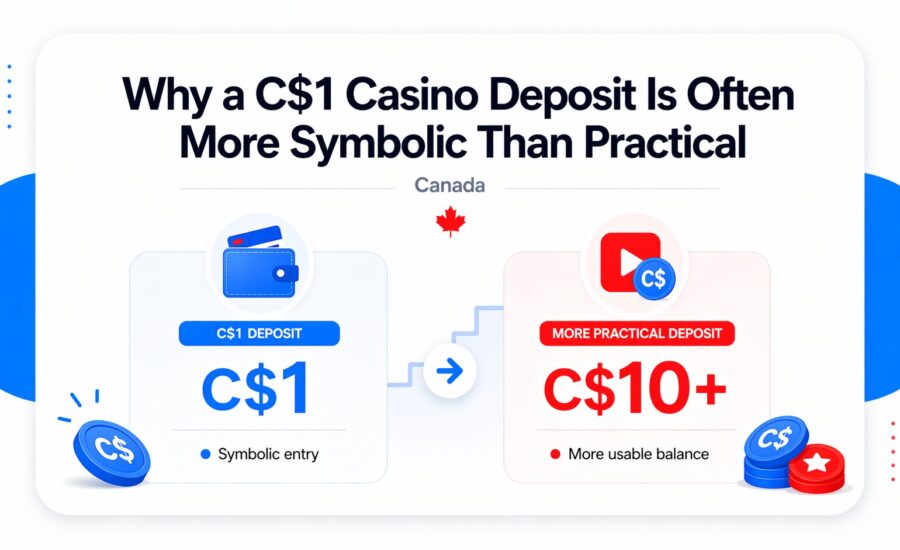
A C$1 casino deposit in Canada can look appealing because it promises the lowest possible real-money entry point. For cautious players, that sounds like a simple way to test a casino without committing much upfront.
In practice, though, a C$1 deposit is often more symbolic than practical. It may be enough to open a real-money session or check whether a payment route works, but it does not always create a useful balance, unlock a meaningful bonus, or give the player much room to judge the casino properly.
This guide explains why a C$1 casino deposit often works better as a low-cost test than as a genuinely practical starting point, and when a slightly higher deposit can offer more realistic value instead.
In practical terms: a C$1 deposit can prove that a casino accepts very small payments, but that does not necessarily mean it gives the player a strong or usable starting point.
On this page
- Why do C$1 deposits look so attractive?
- Why is a C$1 deposit often symbolic?
- What can a C$1 deposit do well?
- Where does a C$1 deposit usually fall short?
- Why is bonus value often limited?
- When does a slightly higher deposit make more sense?
- What players often miss
- How to decide if a C$1 deposit is worth it
- Which pages to compare next
- FAQ
Why do C$1 deposits look so attractive?
The appeal is easy to understand. A C$1 deposit feels extremely low-risk, especially for players who want to test a new casino without putting much money into the account. It can also make a casino appear more accessible than competitors advertising higher entry thresholds.
That marketing angle works because the number is memorable. A one-dollar deposit sounds unusually cheap and can create the impression that the casino is highly flexible for budget-conscious players.
Why is a C$1 deposit often symbolic?
A C$1 deposit is often symbolic because it proves access more than it creates usable value. It shows that the casino may accept a very small payment, but that is not the same as saying the player can do much with that amount once it arrives in the balance.
At very low deposit levels, the difference between technical access and practical value becomes much more noticeable. A player may successfully fund the account, yet still have too little balance to test the games properly, activate the welcome offer, or judge how usable the casino really feels in normal play.
Editorial takeaway: the smallest deposit is not always the most useful deposit.
What can a C$1 deposit do well?
There are still cases where a C$1 deposit can be useful. For some players, it works as a low-cost way to confirm that the cashier is functioning, that their chosen payment method is accepted, or that the casino account setup is working as expected.
- It can help test the cashier with minimal cost.
- It can confirm whether a payment method processes successfully.
- It can offer a very low-commitment first look at a casino.
- It may suit ultra-cautious players who care more about testing than playing.
That is why C$1 deposits still have a place in the market. The issue is not that they are fake. The issue is that they are often better for verification than for meaningful use.
Where does a C$1 deposit usually fall short?
The biggest weakness is that a C$1 balance rarely gives much room to assess the full player experience. Even if the deposit works exactly as advertised, the amount itself may be too small to support a realistic session.
| Area | What a C$1 Deposit Can Do | Common Limitation |
|---|---|---|
| Cashier testing | Shows that the payment route may work | Does not prove the wider casino experience is practical |
| Gameplay testing | May allow a very limited real-money test | Often too small for a meaningful session |
| Bonus access | May sometimes technically qualify for a small offer | Often does not unlock the main welcome bonus |
| Decision-making | Can give a first impression | May not tell the player much about long-term usability |
That is the central problem. A C$1 deposit can be real, but still too thin to be genuinely useful for most players.
Why is bonus value often limited?
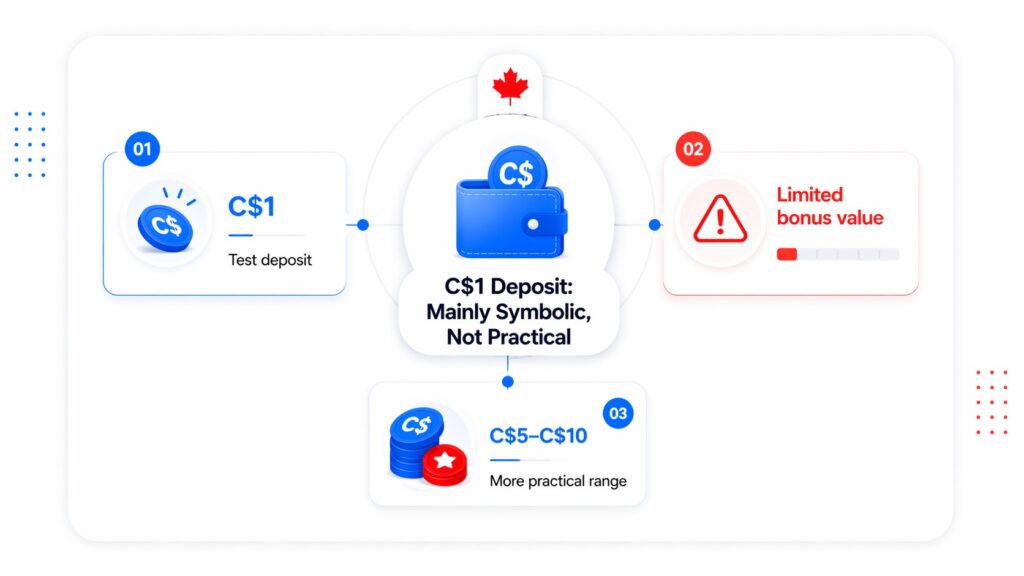
Very low deposits often run into a second problem: even when the deposit is accepted, the associated bonus value may be weak, partial, or unavailable at that level. Many casinos separate the minimum deposit accepted in the cashier from the higher amount needed to activate the main welcome offer.
That means a player may be able to deposit C$1, but the meaningful promotional threshold may start at C$10, C$20, or more. In those cases, the C$1 route remains real, but mainly as a symbolic entry point rather than a strong bonus route.
Related reading:
When does a slightly higher deposit make more sense?
For many players, a slightly higher deposit works better because it creates a more practical balance between cost and usefulness. That is often why low-deposit thresholds around C$5 or C$10 feel more realistic than the absolute minimum.
A somewhat higher amount may still be budget-friendly while giving the player more room to test game choice, judge bonus value, and decide whether the casino suits their habits. This is also where the difference between symbolic access and practical access becomes much clearer.
Related pages in this cluster:
- 1 Dollar Deposit Casinos in Canada
- Minimum Deposit Casinos
- Low Deposit Casinos Canada
- C$10 Deposit Casino Bonuses in Canada
What players often miss
Players often treat the existence of a C$1 deposit as proof that the casino is ideal for low-budget play. That conclusion is not always justified.
- A C$1 deposit can be useful without being practical.
- The lowest entry point does not automatically deliver the best value.
- Very low deposit amounts often support testing better than real comparison.
- A small increase in deposit size can sometimes improve the experience disproportionately.
This is why the smartest comparison is not just “Which casino accepts C$1?” but also “What can I realistically do with that C$1 once it is deposited?”
How to decide if a C$1 deposit is worth it
The answer depends on your goal. If you mainly want to test the cashier or confirm that the payment route works, a C$1 deposit can still make sense. If you want meaningful bonus value or enough room to assess the casino properly, a slightly higher amount may be the more useful choice.
- Decide whether you want to test or actually play.
- Check whether the C$1 deposit qualifies for the welcome offer.
- Review whether your payment method supports that amount cleanly.
- Ask whether the balance will realistically let you judge the casino.
- Compare whether a C$5 or C$10 route gives noticeably better value.
In practice: a C$1 deposit is best viewed as a testing route first and a practical gaming route second.
Which pages to compare next
If you are evaluating small-budget entry points in Canada, these pages are the most useful next steps.
- 1 Dollar Deposit Casinos in Canada for the direct C$1 category.
- Minimum Deposit Casinos for the broader small-entry overview.
- Low Deposit Casinos Canada for the more practical small-budget range.
- C$10 Deposit Casino Bonuses in Canada for a stronger low-budget bonus route.
- Why Casino Minimum Deposits Vary by Payment Method in Canada if you want to understand method-specific differences too.
FAQ
Is a C$1 casino deposit real?
It can be real in the sense that some casinos do accept very small deposits. The bigger question is whether that amount is useful in practice.
Does a C$1 deposit usually unlock the full welcome bonus?
Not usually. Many casinos accept small deposits but reserve the main welcome bonus for a higher qualifying amount.
Why is a C$1 deposit often called symbolic?
Because it may prove that the casino accepts a very small payment without giving the player enough balance to judge the casino properly or use the bonus meaningfully.
Is a C$1 deposit still worth trying?
Yes, if your goal is to test the cashier or make a minimal-risk first check. It is usually less effective if your goal is a practical real-money session.
What usually works better than a C$1 deposit?
For many players, a slightly higher amount such as C$5 or C$10 offers a better balance between low cost and practical value.
Last updated: April 22, 2026